
The Legend of Sam Story
Chief Sam Story and the End of the Euchee Valley
Deep in the Euchee Valley, a stretch of high, fertile ground set apart from the coastal marshes, the story of Chief Sam Story—also known as Timpoochee Kinnard—took root. His life came to symbolize a fragile moment in Walton County’s past, when Native peoples and incoming settlers briefly shared the same land, before the balance irrevocably shifted.
Sam Story’s legacy stands at the crossroads of two worlds: one rooted in centuries of Native tradition, the other driven by relentless American expansion.
A Man of Two Worlds
Sam Story was the son of Timothy Kinnard, a Scottish trader, and a Yuchi woman. In the matrilineal culture of the Yuchi, identity followed the mother’s line, and Sam was fully Yuchi. Yet his European ancestry and fluency in English allowed him to navigate relationships with the growing number of white settlers entering the region in the early nineteenth century.
By the time the American Revolution had faded into memory, Sam Story had emerged as the respected leader of approximately 500 Yuchi people. His village stood at what became known as Story’s Landing, a strategic crossing on the Choctawhatchee River near Bruce Creek, placing it at the center of trade and travel through the interior.
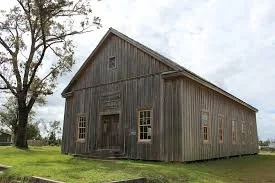
Presbyterian Church in Euchee Valley
A Dangerous Hospitality
In the spring of 1820, Sam Story encountered a group of Scottish families seeking land, among them Neill McLennan. According to local tradition, the meeting was marked by an extraordinary gesture of trust.
It is said that Sam Story handed McLennan his tomahawk—a powerful symbol of peace—and told the newcomers they could claim as much land as they could “blaze” around the valley. Whether literal or symbolic, the story reflects the Chief’s desire for coexistence rather than conflict.
Across Bruce Creek from the Yuchi village, the settlers established the town of Eucheeanna, which would later become the first county seat of Walton County. For a brief time, Native families and Scottish settlers lived as neighbors, trading goods and sharing the valley’s resources.
The Tragedy of the “Lotus Land”
This period of harmony—often remembered locally as a peaceful “Lotus Land”—proved short-lived. As additional settlers arrived from the north, the balance shifted. Forests were burned to clear farmland, game was hunted without restraint, and deer were killed out of season, including nursing does—an act that deeply disturbed Sam Story and violated long-held Native customs.
To the Chief, the destruction was not merely environmental but spiritual. The land that had sustained his people for generations was being transformed beyond recognition.
The End of the Euchee Valley
By 1832, Sam Story reached a painful conclusion: the Yuchi could no longer remain in the Euchee Valley. That year, he undertook a six-month scouting journey into the Florida Everglades, searching for a new homeland where his people might live beyond the reach of American settlement.
The journey took a heavy toll. The aging Chief returned to the Choctawhatchee River exhausted and gravely ill.
The Burial
Sam Story died before the migration could begin. Honoring his life and leadership, his Scottish friends buried him near the confluence of the Choctawhatchee River and Bruce Creek. A marker near the site still commemorates his role in Walton County’s early history.
The Great Departure
After three weeks of mourning, the approximately 500 Yuchi people of the Euchee Valley loaded their canoes at Story’s Landing. They paddled south and east into the Florida wilderness, disappearing from the land they had long called home. Some joined the Seminoles, later resisting removal during the Seminole Wars. Others were eventually forced west to Indian Territory (present-day Oklahoma).
What Remains
Today, the Euchee Valley Presbyterian Church and the ghost town of Eucheeanna stand as quiet witnesses to a brief, remarkable chapter in Walton County history—a moment when Native leaders like Sam Story chose generosity and diplomacy, even as the world around them was closing in.
His story is not simply one of loss, but of dignity, restraint, and an enduring reminder that Walton County’s foundations were shaped long before county lines were drawn.